Tuesday, February 12, 2013

Sunday and Santeria: Calling Down the Orisha


Dancers and musicians teaching Rumba at Callejon de Hamel


Our first Sunday on the island began at the Callejon de Hamel, the first and oldest Afro-Cuban art project in Havana. Here, was my first authentic introduction to Santeria/Yoruba religious practices. I was familiar in the way that most Americans are familiar with Afro-centric religions. The message from our Euro-centric world is that these religions are not normal. They are not “real religion” being full of animal sacrifice, voodoo, candles, zombies and whirling dervish type black men and women caught up in dancinc around a huge bond fire, where you can cut the sexual tension with a knife.


Instead of being told that Yoruba/Santeria was the religion of our ancestors, we are told these so called “pseudo-religions” are to be feared and shunned as not being religious at all. Not real in the sense that Christianity or Catholicism is real.

However, the truth of the matter is that Christianity and Catholicism are as “made up” as they want us to believe that Santeria/Yoruba is. One has become Euro-centric in practice, if not in origin, while the other remains Afro-centric and frowned upon by those who hold the dominant Euro-centric view of the world.

In 1992, Cuba amended its constitution to allow for total religious freedom. It wasn't always this way, at times, there was a very fractious relationship between church and state. But no more. Cuba is considered a Christian country with roughly 25% of Cubans calling themselves Catholic.


Santeria, which is a blend of Catholicism and Yoruba, is widely practiced. Yoruba religion came with the slaves transported to Cuba by Spain, who baptized their property and taught them simple prayers. The slaves combined this tiny taste of Christianity with their own older Yoruban practice and thus gave birth to Santeria.

In colonial times, the Spanish confused Santeria with black magic, witchcraft, accusing practicioners of being criminals and bad people. These prevailing beliefs forced those who kept the Afro-Cuban cultural practices to worship in secret. For a long time, Santerian believers were persecuted, hunted and sometimes killed.


Santeria Altar inside Callejon de Hamel

Rules for sending wishes to the Orisha

Fortunately, times have changed. At least in Cuba, Santeria is no longer viewed as subversive, but is now considered an important religion in the world outside Euro-centric America. Which brings me back to The Callejon de Hamel, Havana's oldest Afro-Cuban Cultural Center.

Here we learned about Rumba, the dance and its importance in Santeria worship. We learned about the importance of drums, music, call and response, and about how to call the Orisha, the spirits to help in our lives. I can't remember all of the names, because there are many Orisha, 600 by some counts. However, I do remember Yemaya and Oshun, two who continually keep popping up in my own personal world on a regular basis, even when I'm not in Cuba.


Gifts to the Orisha inside a private home

Orisha altar kept behind the door

Yemaya is the goddess of maternity. Her colors are blue and white. She reigns over the seas and lakes. She reveals herself to her followers as their mother. Oshun governs the oceans and hills. Her color is yellow. She is the sister of Yemaya and concubine of Chango, the war god of thunder, fire, drum and dance. His color is red.

There were many statues and offerings to the Orisha, placed in various locations within buildings and homes, as well as without. There were places to pray and to seek favor. The Center had what looked like a closet with no door. Inside was a bell, and a list of rules for calling the Orisha. Say a prayer. Ring the bell and gain relief.


Even though my journey on the island was just beginning, I prayed to the Orisha to bring me back in the future.


More to come...


Saturday, February 9, 2013

A Calmer and Less Stressful Time


Going to Cuba is like stepping into a way back machine, beaming back to the time before cell phones and computers and the internet.


To be sure, those things exist in Cuba, but they don't dominate life to the extent that they do in other parts of the world. I was told going in, that my cell phone and my ATM card wouldn't work nor would my credit cards be honored. Everything was cash and carry. Their cash, the CUC. Back in the day, Cuba worked on the dollar, but not anymore. The reason for this is the US' ongoing embargo against Cuba. Nothing USA works in Cuba, not even money, and it didn't used to be like that. For the first time in a great while, I traveled with all the cash I would need, in my pocket. The trick was to budget well enough to get off the Island before the money ran out, because money transfers were also shaky, I was told.

During our tour of ISLA, which is the University of Art, one of my friends remarked at seeing laptops for the first time since our arrival in Havana, nearly a week prior. We were walking down a hallway where some students were seated on the floor, working on their computers. It seemed to be a wifi hotspot. No big deal for a university, except that we hadn't seen it before, except among the tourists in the lobby of our hotel. Wifi is not free. It costs to hook up for even a half hour. And that half hour or hour can be very expensive. 
 

The same with cell phones. No need to worry about bumping into some fool in their own world walking down the street and not paying attention to what is going on around them, as they shout into the receiver, seeming oblivious to the fact that others don't give a damn about their personal business. You can actually hold a conversation, a real conversation around a dinner table in a Paladar without being interrupted by a cell phone ringer. Our tour guides were constantly using their phones, but only to deal with our ever changing itinerary, or Abel to talk with his wife. Even though he lives in Havana, he lives with his tour group when working, so he touches base like a good husband should. We were able to meet his wife and his daughter, both beautiful women for a beautiful man.

Pay phones were everywhere, unlike in the US where the public phones have disappeared off the streets to discourage drug dealers. Of course, by taking away public phones, poor people were also disenfranchised, but nobody seemed to care.  Like the United States, drug dealing is illegal in Cuba. In fact, so is drug use and it is not tolerated. We were even told by a doctor at a state run clinic that there was no alcoholism in Cuba. We were skeptical until we were accosted by a friendly drunk in the street, while on one of our walking tours. Eliminating public phones is not viewed as a way to fight alcoholism or drug use in Cuba. so public phones were along the roads, some in the hallways outside the toilets.

 Nobody calls them restrooms in Cuba, that is in fact an Americanism. You don't “rest” in a toilet. You are there to do your business, period. You sometimes don't even have a toilet seat covering the porcelain throne. Marie remarked on more than one occasion that the way to make a fortune in Havana was to become a plumber. Toilet paper was also a luxury and if you didn't have tissue in your pocket, you could buy some from the Senora sitting outside the door.


Havana is a city where the stoplights come with a countdown. You actually know how many seconds remain til you can go or stop or have to get through the intersection before the light turns. The roads are very narrow, 18th century narrow, and sometimes cobble stoned. The highway to Santiago was fairly modern while near the city, but became less well paved as we left civilization, so to speak. The speed limit between cities was 100 mph, I'm told, but our bus driver chose to drive under that. His speed was dictated by the condition of the roadway, good in some spots, not so good in others. Traffic signs in the neighborhoods placed the speed limit at 60mph as opposed to the 35 or 25 mile zones in American residential areas.


And no, the pedestrian is not always right in Havana. We were warned not to ever step into the street and walk like an American, as if you own the place. You don't. Failure to yield to the bike, horse, car, goat or two wheeled taxi bearing down on you, could turn you into roadkill.

Regardless of the differences, we adapted to the rhythm of the streets very quickly, which amounted to slowing down and seeing what and who surrounded us. People still look you in the eye and speak to you, here. Men and some women still flirt. Another exhale moment under the afternoon sun.

More to come....


Wednesday, February 6, 2013

The Kindness of Strangers


I've taken many adventures over the years, and the one consistent thing in all of them is the people that I meet. Like Blanche DuBois, I live for the kindness of strangers. They are strangers only until the moment we meet. Then, they become friends, if only for a very short time.

They succeed in changing my life for the better. We meet. We laugh. We talk. We share an experience and then we move on., both of us changed, hopefully for the better. But I can only speak for myself.

Taking a sun break in downtown Havana

With one exception, that being Marie, I may never see the people in our group again, nor our tour leaders. However, I know that should one or all of us come to stand on the same earth once again, we will be friends, never missing a beat.


Marie is a constant in my life. We have been friends for more than 20 years. I am very happy to have shared this adventure with her.
Marie and the Cigar Lady

The people that I met in Cuba stay real for me because I save the things they touched and gave me, like the thank you note from our hotel maid, that I didn't realize that I saved. There was a woman who gave me a Cuban Peso for luck as I browsed in a bookstore. She told me to keep it close and then disappeared back into the crowd. The Peso is in my pocket now.

The band at Tocororo a Paladar that I really and truly plan to revisit. They treated us like homies out for a night of food and fun. We laughed and sang along with a very talented group of musicians who made us feel at home. They autographed a CD of their music for me.


Joseph, no last name, a student at the University with whom we talked politics and social issues both US and Cuban. American politics. Thanks to Joseph, Mitt Romney will forever be called Mitt RocK-ney by me. Even now the misnomer brings a smile at the memory. Fancy that, finding an Obama supporter in Havana. According to Joseph, President Obama was the man of choice by the people.
Outisde Lazaro's Papier Mache House

The notes and proffered email address from Alberto Faya, a famous man in his country, a performer, TV personality and teacher, who left me with a thirst and hunger for learning “history without the holes” punched into the story fabric by wannabe larger than life, Europeans, fearful and disdainful of indigenous peoples they seemingly conquered.

Said Faya, it may seem like they erased Africans, erased slaves, erased the indigenous people, but they really didn't and Cuba is proof of this.

Entertainment outside El Morro Castle
Pro Danza Dance Company

“Preserving culture is preserving life,” Faya told us, and he drew the parallels and connections allowing us to see history in total, for the first time. I struggle to explain to you what his short lecture taught me or how it made me feel, except to say that I want more of it. I finally exhaled in understanding what it was that he said.

During our entire time in Cuba, Marie and I never saw another Black American and it was okay. Not finding Black Americans anywhere but the USA is pretty much the norm in my travels and Marie's too. We talked about it. We are troubled that American Blacks don't travel and don't seem to want to. Both of us talked about how we were greeted with perplexed stares and silly questions after revealing that we were going to Cuba. The first question from our acquaintances, family and friends was always “why?”

We say, “why not?” If they did travel, it would help make the cosmic connection that “we” are not alone in this universe, that slavery, never did define “us” as a people and that “our roots” run so deep that we will never, ever be eradicated by any so called conqueror who fears “our existence.”

The people of Cuba are our home, our familia.

More to come...

Monday, February 4, 2013

A Dog Day Afternoon


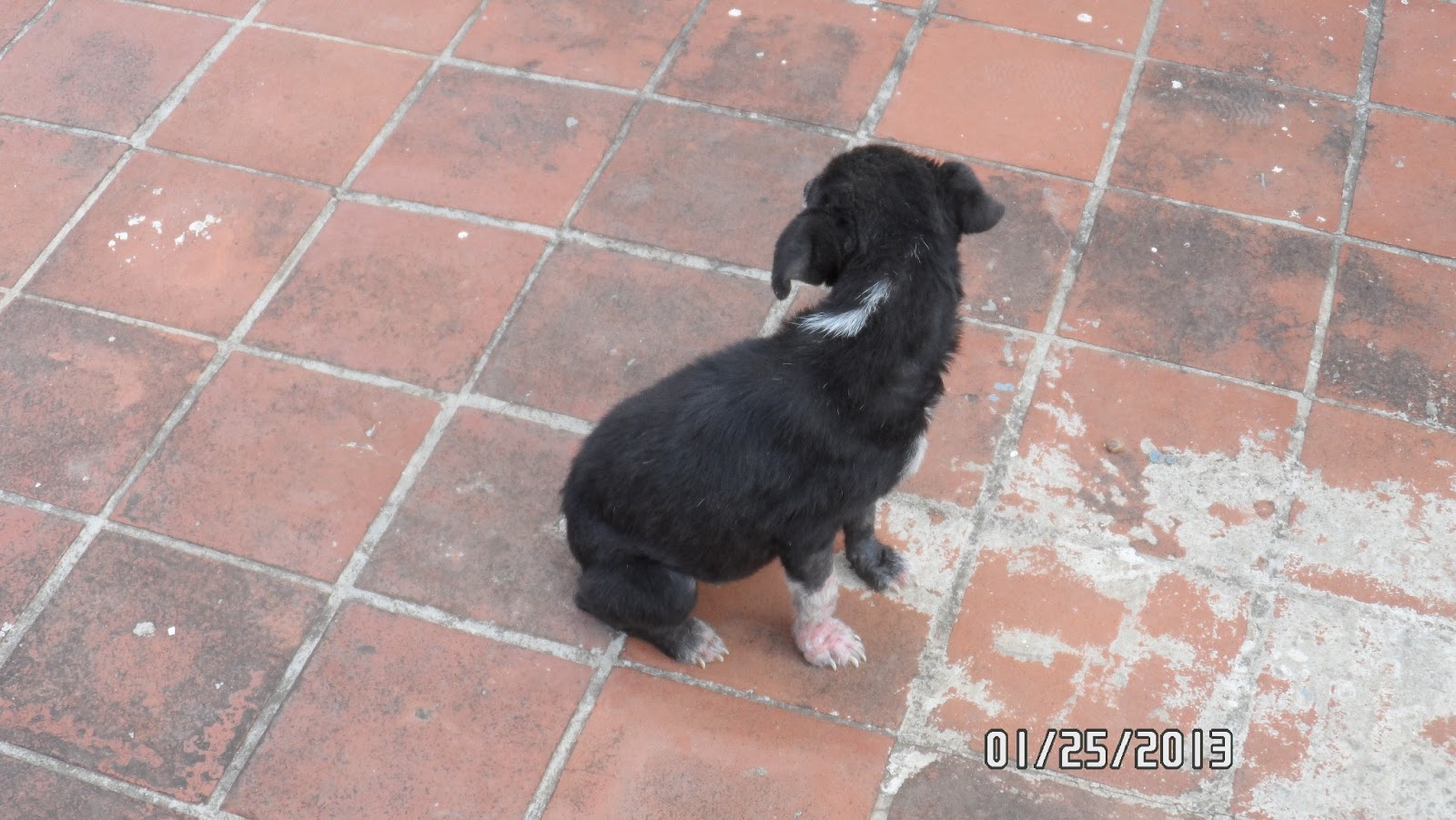
Leaving the Paladar, the first thing that struck me were the number of stray dogs hanging around, near where our driver, Camillo had parked the bus. I assumed they were strays because they were unusually thin and hungry looking as well as small in stature compared to the dogs I see in the US. Wiry little and medium sized terrier mixes were all over.

They were also not aggressive. Many, and there were about 10 or so, lying on the ground taking a nap. Others were playing. That many stray dogs in one spot would have caused concern, here at home. However, these dogs were as laid back as the people who were also nearby buying goods and snacks from a small store that fronted the parking lot. Neither the people nor the dogs were concerned about each other. It was obviously a peaceful, non stressful co-existence, one that I saw replayed in every venue in which we ventured. The dogs were literally everywhere, and it is a situation that does not exist in the US.

The Cuban dogs showed me that our dogs, our pets are as high strung and stressed out as most of us are. American dogs are very vocal, very aggressive, very jumpy and very leery of people, especially with strangers. You almost never see in public a pack, of dogs, let alone one or two at a time.

Where I went, there were dogs, most of whom were obviously strays, dirty, mangy, showing signs of combat and survival, ribs showing. They were looking for food, or napping in the middle of the square, or taking shade near a big planter as people walked by pursuing their day, not concerned about the dogs. The dogs not concerned about the people.

During my entire time in Cuba, I counted four dogs being walked by leash, two pekinese living the life on a parch over a Paladar getting set to open and doing the American thing of barking at passersby. The two peks were shiny and obviously well kept, real lucky dogs.

We treat our pets like possessions, like a new hat or designer label adornment, denying or refusing to allow them to express their “animal-ness,” preferring to turn them into furry little human like critter/companions. In Cuba, a dog is a dog, an animal that is also part of society or existing on the fringes, with an equal right to the planet.

More to come..


Thursday, January 31, 2013

Yes, We Have No Bananas


Where to begin. Of all the days spent in Cuba, the first day remains a blur, dominated by clearing customs, TSA and the immigration Nazis in two countries within hours is enough to jangle even the sturdiest of world travelers. There were lines and more lines controlled by non smiling or non English speaking people, not because they couldn't speak English, but because they didn't have to, since most of the people in line spoke Spanish.

View from El Morro Castle overlooking Caribbean Sea

Where I had been cautious in my packing by making sure everything fit into my rucksack and one bag, others in line toted huge packages of green plastic shrink wrapped goods to take into Havana. Some of it was identifiable as car tires, bulk toilet paper or paper towels. There were tools and plumbing parts. Things that I would later learn, are impossible to purchase in Cuba thanks to the United States 60 year embargo coupled with the fall of Russia back in 1991.

When the Soviet Union dissolved, Cuba was left hanging with no trade partners, America turned its back on Fidel Castro, ticked off because he kicked them out of their favorite playground, and nationalized and confiscated American holdings in Cuba. JFK mounted a boycott and tried unsuccessfully to assassinate El Presidente a number of times over the years in retaliation.

Stuff like that makes for some harsh feelings to say the least. With no one to trade with, the island fell into decay, so to speak, unable to sustain itself. While it is recovering, total recovery has been an arduous process with some things still in short supply, as the United States continues to sulk about losing its Caribbean playground, while paying more attention to the feelings of the displaced, rich white Cubans in Miami than the brown ones in need in Cuba.

This Cuban scenario is similar to the one played out between the US and Haiti when it sought its independence from France. The US allied itself with the white Europeans fearing a slave backlash on its own turf. US actions continue to reverberate today in modern times as both Haiti and Cuba are left to struggle while the US turns a deaf ear and shrugs.

Another thing in short supply that took me and Marie by surprise was the fact that there was a banana shortage. A banana shortage in a place sometimes referred to derogatorily as a “banana republic.” A place that supplies the fruit to the rest of the world. But there was a good reason for the shortage.

Balcony view in Old Havana

Seems Hurricane Sandy blew all the ripening fruit off the trees when she hit the island, so plantains and bananas were scarce. The same held true for coconuts too. Sandy did a number on the island. If we didn't see actual destruction, we saw red roofs on buildings. The red a sign that it had recently been replaced. We saw whole neighborhoods of red roofed homes and buildings during our travels, especially in and around Santiago de Cuba, which is at the opposite end of the island from Havana.

I was blown away by the “oldness” of everything. The cars, American mainly, dating back to the early 50's, yet still running. The buildings harking back to precolonial times, still standing, still useful, still occupied. Some painted and renovated while others were in varying states of decay and disrepair. Old faded decadence covered over with new, vibrant paint. Brilliant colors guaranteed to offend any housing or condo association in the US that can't see past beige or white or other boringly neutral colors of American status. Old, decayed, but clean. Very clean.

La Ferminia Restaurant Havana, Cuba
Tapas serving at La Ferminia

Following our city drive through, we were taken to La Ferminia a restaurant that served Tapas style. Back in the day, when the wealthy, primarily white Cubans fled Havana in the wake of the revolution, they left their belongings, their homes, their cars and all of their stuff. Those homes became “found” materials and were eventually put to other uses. Many of these homes were transformed into restaurants. They became what are called Paladars. It's like going to dinner at a friend's house, where your friend hires servers and a band to entertain you. Comfortable.

More to come..

Wednesday, January 30, 2013

Looking for Assata Shakur, But Finding Me, Instead


I'm long past the days of jumping airplanes on the spur on the moment. My ready bag was not ready. I was no longer working for anyone other than myself and I was now traveling on my own dime, so while I have always wanted to go to Cuba, there was a new caution in my step.

Cuba is still embargoed for Americans, basically, meaning I couldn't just go and enjoy myself. I had to ally myself with a tour group, Insight Cuba, something that I have always tried to avoid at every opportunity. Tour groups are okay, but I always feel like a kid having to ask the babysitter if I can go to the bathroom, when I'm on a tour. Insight Cuba is the best of the best. I was very pleased and would travel with them again, despite my innate reservations about tours.

I love being able to make decisions about where, when and how to go, on my own. On a tour it is hurry up and get someplace with no time to savor the moment. I need to taste my food, my drink. I need to smell the place. I need time to trip over the curb and to stumble over the cobblestones in the roadway. I need to talk to the people in my path, pet the dogs who venture near, and watch the street play happening around me.

Looking out at El Malecon from Melia Cohiba Hotel

I don't know when or even if President Obama will lift travel restrictions, so I decided to go now, with a tour, because I can always return, if I like it.

“Like it!” Ha! Cuba felt like going home. I exhaled. It felt like I'd been born there, just returning after a lifetime trip into the outer world. My Spanish sucks, but it didn't matter. I understood what was going on around me as if I was simply walking around my own neighborhood in Cincinnati, Ohio.

And I was greeted like a native, starting on the plane from Miami. My seat mate was an old man in a brown suit, vest and tie, wearing four hats piled on top of his head. It was an easy way to carry so many hats. He also had a couple of others in each hand. He didn't talk at all until we landed at Jose Marti International Airport, when he turned to me and asked me if I was home to visit family. He said this in Spanish. Since he spoke slowly I was able to understand completely, what he said to me.

I told him in my broken Spanish that I was an American on vacation and not Cuban. He turned and looked squarely at me and said, “but your family is here, you are Cuban?” I told him “no.” The look in his eyes told me he didn't believe me, but he was polite about it, and we parted to gather our belongings.
Downtown balcony view from Hemingway House

My friend Marie smiled at the exchange. It was the first of many times per day that I would have to explain that I was away from home, not returning home.
It was also the first indication, here on this trip, that Black Americans don't travel. We tend not to leave our neighborhoods to even cross the street. As Marie and I wandered from Havana to Bayamo and back again, we found Americans, excluding the ones we were traveling with, but not one of them was a Black American.

For the past several years Black Americans have been obsessed with finding their ancestral roots in order to determine where they came from, meaning what tribe in Africa. Our genealogical search takes us from America to Africa with no stops in between. However, judging from what I've seen and heard, maybe more of us should stop first in Cuba before going all the way back to Africa. African culture, religion and history was not erased in Cuba.

The Spanish and Europeans tried. However they were not successful in quieting or shushing the “African-Native Indian noise,” as they were in the United States. Cuba was birthed by a Black woman said historian and professor Alberto Faya and it shows in all aspects of Cuban life. It is the culture of Cuba, fused from Native Indian, African, Spanish and European roots.

To quote Professor Faya, a noted historian, teacher, performer and musician, “preserving culture is preserving life! It is African. We are all African, here.”

Dr. Faya teaches history without “holes.” In America, history is taught to make the European look powerful and dignified while denigrating non Europeans, casting them as less than human, unworthy of historical mention.

I nearly cried as his lecture progressed. I'd waited all my life to hear all of history, inclusive, colorful, equal, an out loud “black and proud” moment that is still reverberating inside me.

More to come..